Insider Buying, Short Interest & Buyback Timing Explained
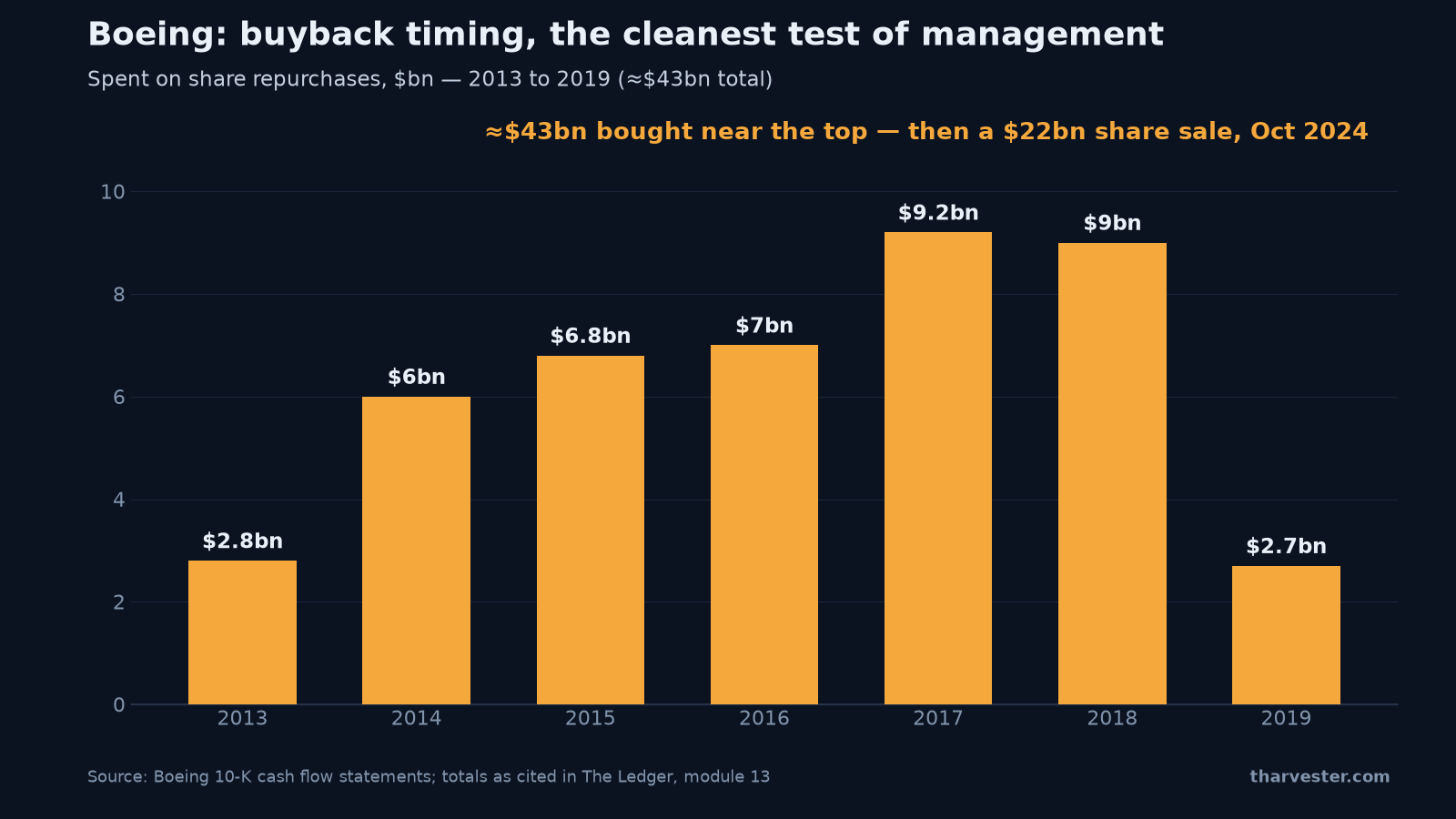
Short answer: Insider buying is a weak-to-moderate positive signal — what matters is open-market purchases by operating executives, sized against their salary, clustered in time. Insider selling is noisy and usually means nothing. Short interest and days to cover are positioning data, fuel and friction, never evidence. And the cleanest test of a management team is buyback timing: Boeing spent roughly $43bn repurchasing shares between 2013 and 2019, then sold $22bn of new shares in October 2024 — buying high and selling low with shareholders' money.
The financial statements tell you what a business did. Ownership data — who holds the shares, who is betting against them, and what management does with its own money — tells you something about what happens next. None of it is fundamental analysis in the strict sense. All of it changes outcomes.
The chart above shows the pattern this module exists to catch: Boeing's spending on share repurchases by year through the 2013–2019 boom, roughly $43bn in total — followed, after the downturn, by a $22bn sale of new shares in October 2024. Bought high, sold low, with shareholders' money. This article walks through the insider buying signal, institutional ownership analysis, short interest, and buyback timing the way The Ledger does — each one read from the long side and the short side.
The insider buying signal — and why selling means almost nothing
Company directors must disclose their share dealings. In the United States every dealing lands on a Form 4 filing at sec.gov. The two directions carry very different amounts of information.
Selling is noisy. Directors sell to pay tax bills, to buy houses, to diversify a fortune that is 90% in one company, and through automatic plans arranged months in advance. One motive out of a dozen is bearish. A disclosed sale usually means very little on its own.
Buying is more interesting, because there is only one reason to do it. Even then, size matters more than the fact of it. A chief executive on a $2m salary buying $30,000 of shares is making a gesture. The same person buying $1.5m is making a statement. The strongest version of the signal is several operational directors — the people who see the order book — buying meaningful amounts within a short period.
The practical test: pull the last twelve months of Form 4 filings, keep only open-market purchases (not granted awards), and compare each against that person's salary from the pay report. A purchase worth a few weeks' pay is a gesture. One worth a year's pay is a statement.
Institutional ownership analysis: who owns it, and why that matters
Institutional ownership is the share of the company held by professional managers — funds, pensions, insurers. The percentage is less interesting than what it implies about the next buyer:
- Very low institutional ownership means either nobody has found the company yet, or professionals have looked and declined. Work out which — the two cases point in opposite directions.
- Very high institutional ownership means the natural buyers already own it. For the price to rise, the next buyer has to be someone new.
- Concentration in a few funds creates a specific mechanical risk: if those funds face withdrawals, they sell what they own regardless of what they think of it. Your thesis can be right and your stock can still fall because someone else's investors wanted their money back.
Short interest percent of float — fuel, not evidence
Short interest is the number of shares sold short, usually quoted as a percent of the float — the shares actually available to trade. Divide short interest by average daily volume and you get days to cover: how long it would take every short seller to buy back their position.
Read it the way the course reads it: positioning data, never fundamental data. High short interest tells you the bet against the company is crowded — which is fuel if the price starts rising and shorts are forced to buy, and friction on the way in, because borrowing shares costs money. It tells you nothing about whether the shorts are right. The mechanics of borrow cost and squeeze risk get a full treatment in the previous article in this series, short selling analysis: borrow, carry and squeeze risk.
Buyback timing: the cleanest test of a management team
Buybacks are usually described as "returning money to shareholders." Whether they create or destroy value depends entirely on the price paid — and that makes the buyback record one of the cleanest tests of management available.
Here is the arithmetic, straight from the module. A company with 1,000m shares spends $1bn buying its own shares:
- Case A — bought at $25 in a boom: $1,000m ÷ $25 = 40m shares retired. Share count falls 4.0%.
- Case B — bought at $8 in a slump: $1,000m ÷ $8 = 125m shares retired. Share count falls 12.5%.
The same money removed three times as much of the company in Case B. Every remaining shareholder owns a meaningfully larger slice of the same business.
Now the pattern that should worry you: a company that buys heavily at Case A prices and then, when trading turns down, issues shares at Case B prices. It has bought high and sold low with shareholders' money. Boeing's roughly $43bn of repurchases between 2013 and 2019, followed by a $22bn share sale in October 2024, is that pattern at scale — and the same instinct tends to repeat in the next cycle.
Run the numbers yourself in the course's buy-high-sell-low detector:
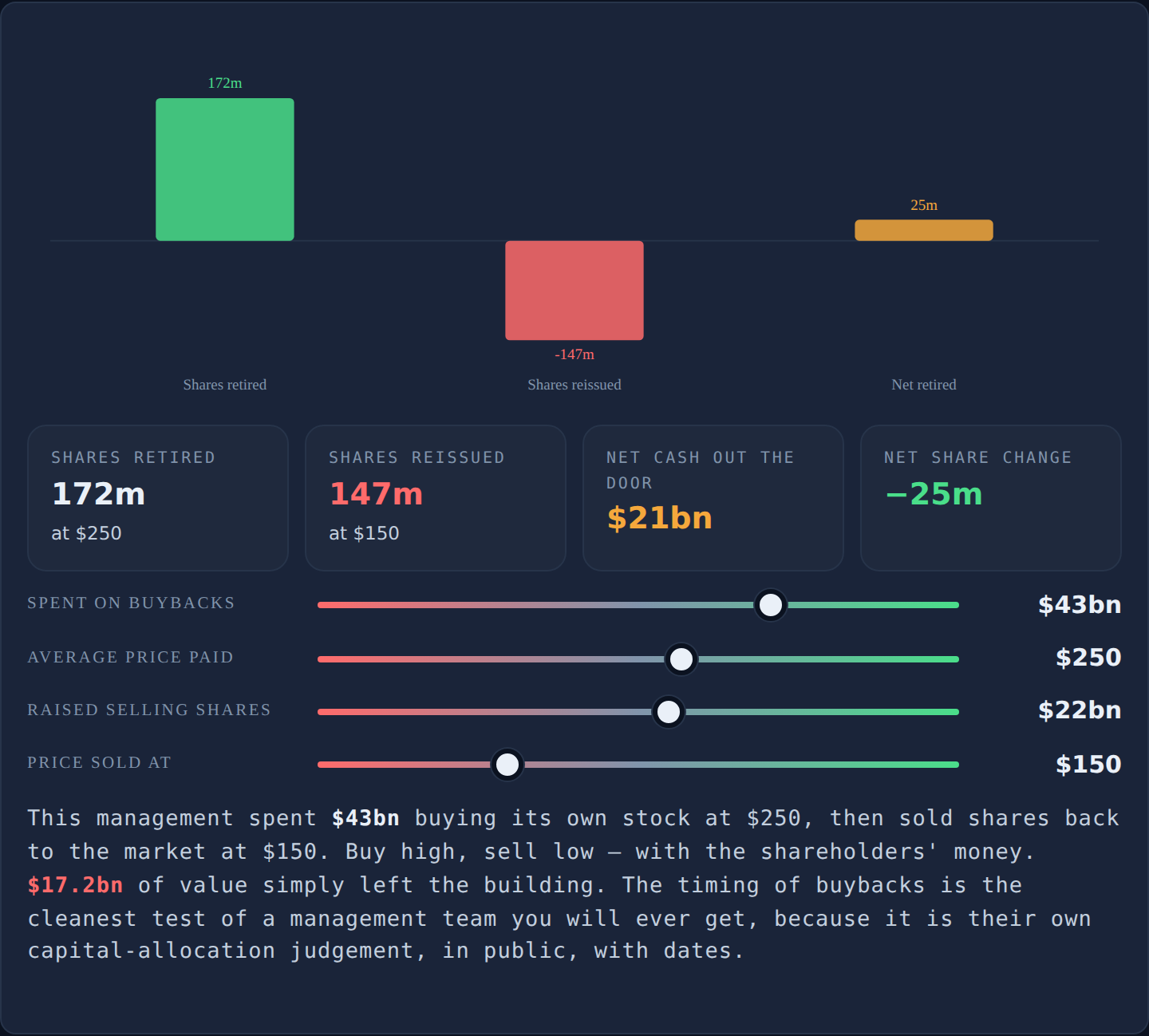
Set dollars spent on buybacks and the average price paid, then set dollars raised selling shares later and the price sold at. The readouts show shares retired versus shares reissued, the net change in share count, and the net cash out the door. Try the Boeing shape: a large buyback at a high price, then a large share sale at a lower one — and watch the net share count reduction shrink toward nothing while the cash keeps leaving. Then flip it: buy low, never reissue, and see how cheaply the same reduction could have been bought.
The five-year test for any company you hold: note buyback spend per year against that year's average share price. Did they buy most when the shares were cheapest? If they bought most at the top, the cash would have created more value sitting in the bank — and you have learned how they will behave in the next downturn.
Executive compensation incentives: read what they are paid to maximize
The remuneration report — the proxy statement, filed as DEF 14A in the United States — sets out exactly which measures determine executive bonuses. It is one of the most predictive documents available and one of the least read:
- Bonuses tied to revenue growth or adjusted EBITDA reliably produce acquisitions and generous definitions of "adjusted."
- Bonuses tied to earnings per share encourage buybacks including when the shares are expensive, because buybacks raise EPS regardless of price.
- Bonuses tied to return on invested capital and free cash flow per share encourage discipline, because both are hard to improve without genuinely improving the business.
Incentives predict behavior far better than strategy presentations do. Read what they are paid for, and you can usually predict what they will announce. If ROIC is new to you, the earlier article on ROIC vs WACC covers why it is the honest yardstick.
One more measure that is not what it seems: beta, which measures how much a share has historically moved relative to the market. It describes past wobbliness, not the risk of permanent loss — a share down 90% in a straight line can have a low beta. Useful for sizing and hedging; silent on whether the business is any good.
Keep going
The full lesson — Ownership, incentives and positioning — adds guided drills: pulling a year of Form 4 filings, mapping the major holders, reading a real pay plan and predicting management's next move, and grading a five-year buyback record. It is module 13 of The Ledger, free with no signup, and the Fundamentals Grader folds share-count discipline into its scoring automatically. Next in the series: how to research a stock — the 10-K reading order, where the proxy statement takes its place in a full research process. Any term that snags, look up in the glossary.
Read ownership and positioning from both sides in module 13 — and judge every buyback by the price, not the press release.
Frequently asked questions
Is insider buying a good signal for a stock?
It is a weak-to-moderate positive signal, and the details decide how much it means. An open-market purchase by an operating director, sized meaningfully against that person's salary, carries real information — there is only one reason to buy. A chief executive on a $2m salary buying $30,000 of shares is a gesture; buying $1.5m is a statement. The strongest version is several operational directors buying meaningful amounts within a short period.
Why is insider selling not a bearish signal?
Because directors sell for many reasons that have nothing to do with the business: tax bills, house purchases, diversifying a fortune that is 90% in one company, and automatic selling plans arranged months in advance. Buying has one motive; selling has a dozen. A disclosed sale usually means very little on its own, which is why The Ledger treats the two directions completely differently.
What does institutional ownership tell you about a stock?
Very low institutional ownership means either nobody has found the company yet or professionals looked and declined — your job is to work out which. Very high institutional ownership means the natural buyers already own it, so the next buyer has to come from somewhere new. Concentration in two or three funds adds a specific risk: if those funds face withdrawals, they sell what they own regardless of what they think of it.
What is short interest as a percent of float?
It is the number of shares sold short divided by the shares actually available to trade. It is positioning data, not fundamental data: it tells you how crowded the bet against the company is, not whether the bet is right. Read it as fuel and friction — high short interest can accelerate a rally through forced buying — and never as evidence about the business itself.
When do share buybacks create value?
Only when the shares are bought below what the business is worth. A buyback converts cash into ownership, so the exchange rate is the share price. A company with 1,000m shares spending $1bn at $25 retires 40m shares, cutting the count 4%; the same $1bn at $8 retires 125m shares, cutting it 12.5%. Same money, three times the ownership — which is why the timing of the record, not its size, is the test.
What is an example of badly timed buybacks?
Boeing. It spent roughly $43bn repurchasing its own shares between 2013 and 2019, near the top of its cycle, then sold $22bn of new shares in October 2024 after the downturn. That is buying high and selling low with shareholders' money, at scale — and the same instinct tends to repeat in the next cycle, which is why the historical record predicts future behavior.
How do executive compensation incentives predict behavior?
People pursue what they are measured on. Bonuses tied to revenue growth or adjusted EBITDA reliably produce acquisitions and generous definitions of 'adjusted'. Bonuses tied to earnings per share encourage buybacks even at expensive prices, because buybacks raise EPS regardless of price. Bonuses tied to return on invested capital and free cash flow per share encourage discipline, because neither improves without genuinely improving the business.
Does beta measure how risky a stock is?
No — beta measures how much a share has historically moved relative to the market. It describes past wobbliness, not the risk of losing money permanently. A share that has fallen 90% in a straight line can have a low beta. It is useful for position sizing and hedging; it says nothing about whether the business is any good.