Options Trading Plan Template That Re-Pegs to Your NAV
Short answer: An options trading plan needs a separate section per strategy, because rules that are correct for cash-secured puts are wrong for long LEAPs. Express every limit as a percentage of NAV rather than a dollar amount, so the figures re-peg automatically when the account changes size.
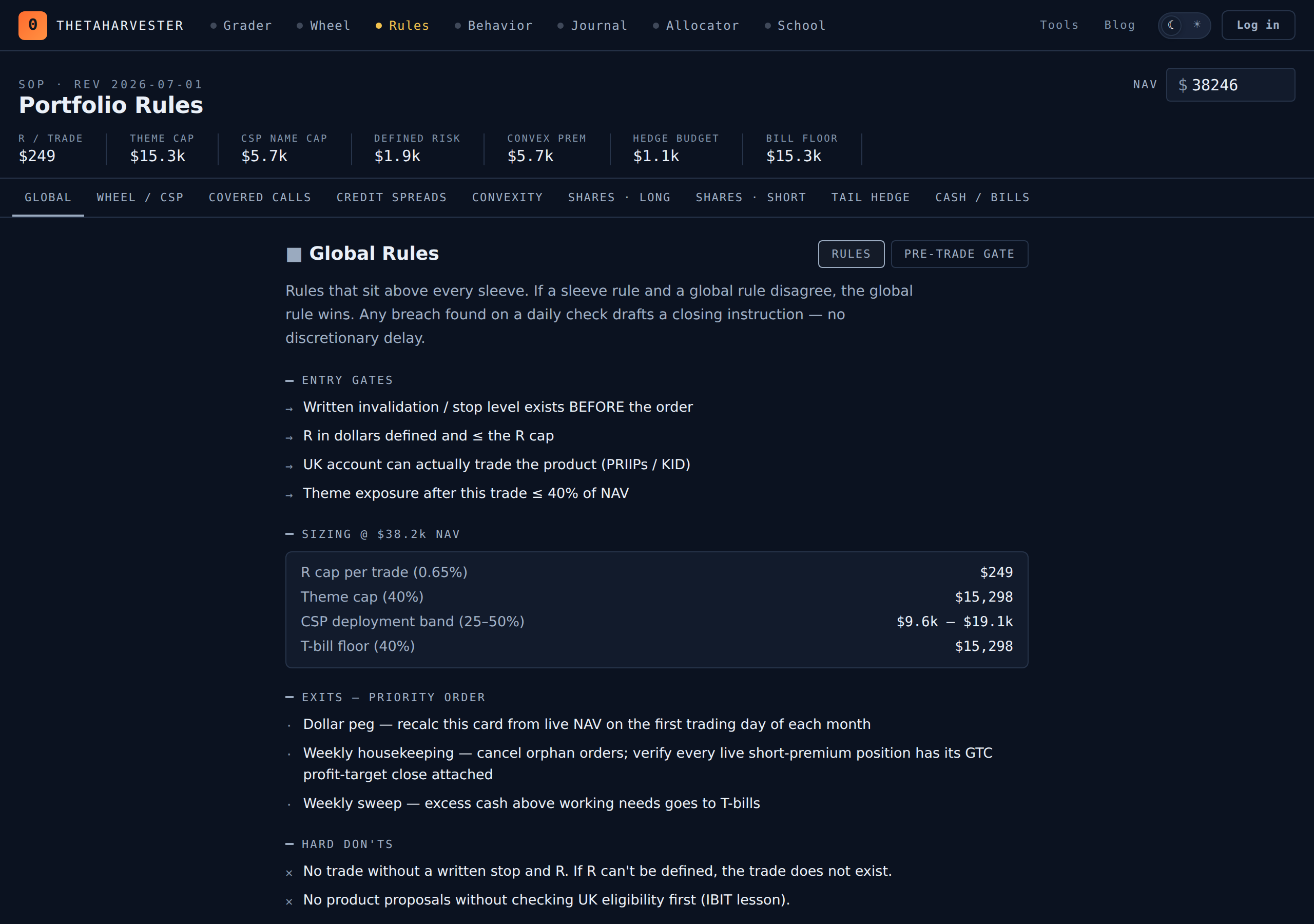
Every options trading plan template you can download has the same defect. It is a document. You fill it in once, and the numbers in it were true on the day you wrote them.
Then the account grows, or it draws down, and the $250 risk cap you set at $40,000 is quietly the wrong number. Nobody edits it. The plan does not fail loudly — it just stops describing what you should actually be doing.
Portfolio Rules is that template built as a live rulebook instead.
Why most options trading plan templates fail
Three reasons, and they compound.
They are written once and never reopened. A plan that lives in a PDF is not available at the moment you need it, which is the thirty seconds before you click confirm on an order.
They hard-code dollars. Every limit in a static plan goes stale the moment your NAV moves. The percentages were the real decision; the dollars were just an instance of them at one account size.
They treat "options" as one strategy. This is the biggest one. A plan that says "risk 1% per trade and take profits at 50%" is coherent advice for premium selling and actively harmful for long convexity, where the whole thesis is that a small number of trades run a long way. One set of rules cannot serve both.
What an options trading plan actually needs
For each strategy you run, five sections:
- Purpose — what this sleeve is for, and explicitly what it is not for. The dormant-sleeve note matters as much as the active one.
- Entry gates — the conditions that must all be true. Not preferences. Conditions.
- Position sizer — the rule that converts your NAV into a number of contracts or shares, today.
- Exit rules in priority order — written before entry and ranked, so that when two apply you already know which wins.
- Hard don'ts — the specific mistakes this sleeve exists to prevent, in the imperative.
Organise by sleeve, not by ticker
Portfolio Rules splits the book into eight sleeves, each with its own complete rulebook:
| Sleeve | Role |
|---|---|
| Wheel / CSP | Core income. Undefined risk, cash-secured. |
| Covered Calls | Income on assigned or held shares only. |
| Credit Spreads | Defined risk, capped share of the premium budget. |
| Long Convexity | Long calls and LEAPs — the positive-skew counterweight. |
| Shares · Long | Assigned stock and deliberate swing positions. |
| Shares · Short | Directional short, its own module and its own limits. |
| Tail Hedge | Crash insurance, funded from a fixed decay budget. |
| Cash / T-Bills | The risk-free floor the rest of the book must beat. |
Splitting the book this way is what stops the most common category error in options trading: applying a premium-selling exit rule to a long-premium position because both are "options".
The Tail Hedge sleeve is the clearest example. It is scored against a decay budget, not against P&L, because it is supposed to lose money most years. Judge it on the same profit-target rule as the credit sleeve and you will cancel your insurance a month before you need it.
Peg every number to NAV, not to dollars
This is the mechanic that makes the difference between a plan and a document.
Percentages are the source of truth. You decide that risk per trade is 0.65% of NAV, that no single theme exceeds 40%, that the CSP deployment band runs 25-50%, that T-bills floor at 40%. Those are the real decisions and they should almost never change.
The dollars are derived. At $38,246 NAV, 0.65% is $249 per trade, the theme cap is $15,298, and the CSP band is $9,600 to $19,100. Change the NAV and every figure on every card re-pegs immediately.
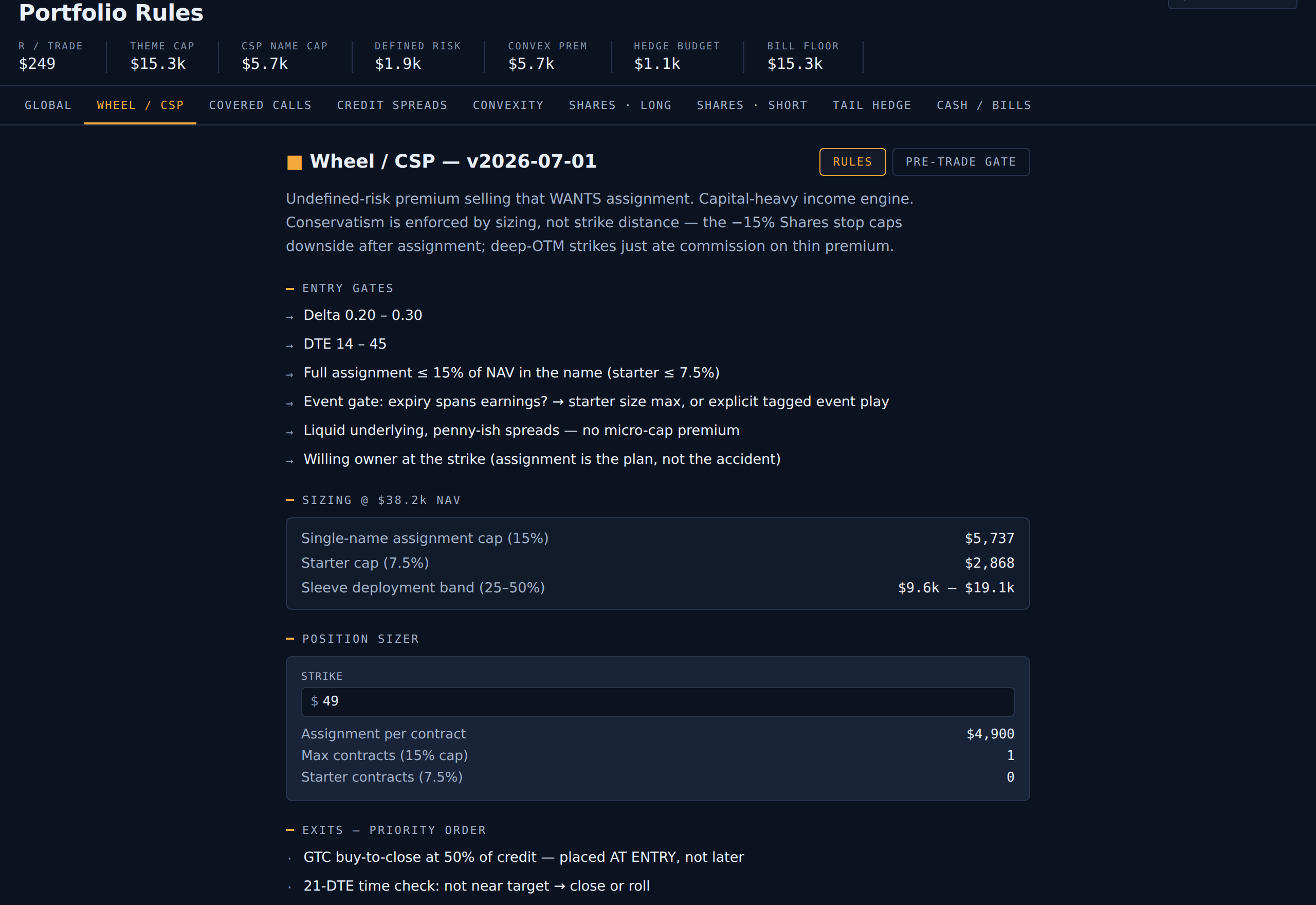
What this prevents is sizing creep — the slow, unnoticed drift where a good quarter leaves your fixed dollar risk representing a smaller share of the account, or a drawdown leaves it representing a dangerously larger one. Neither is a decision you made. Both are what happens when the plan holds dollars instead of percentages.
The same NAV is shared with the Portfolio Allocator, so editing it in either place re-pegs both. The rulebook holds the rules in live dollars; the allocator holds the budgets and checks the book against them.
The pre-trade gate is where a plan becomes enforcement
A plan you consult is better than no plan. A plan that has to be cleared is a different category of thing.
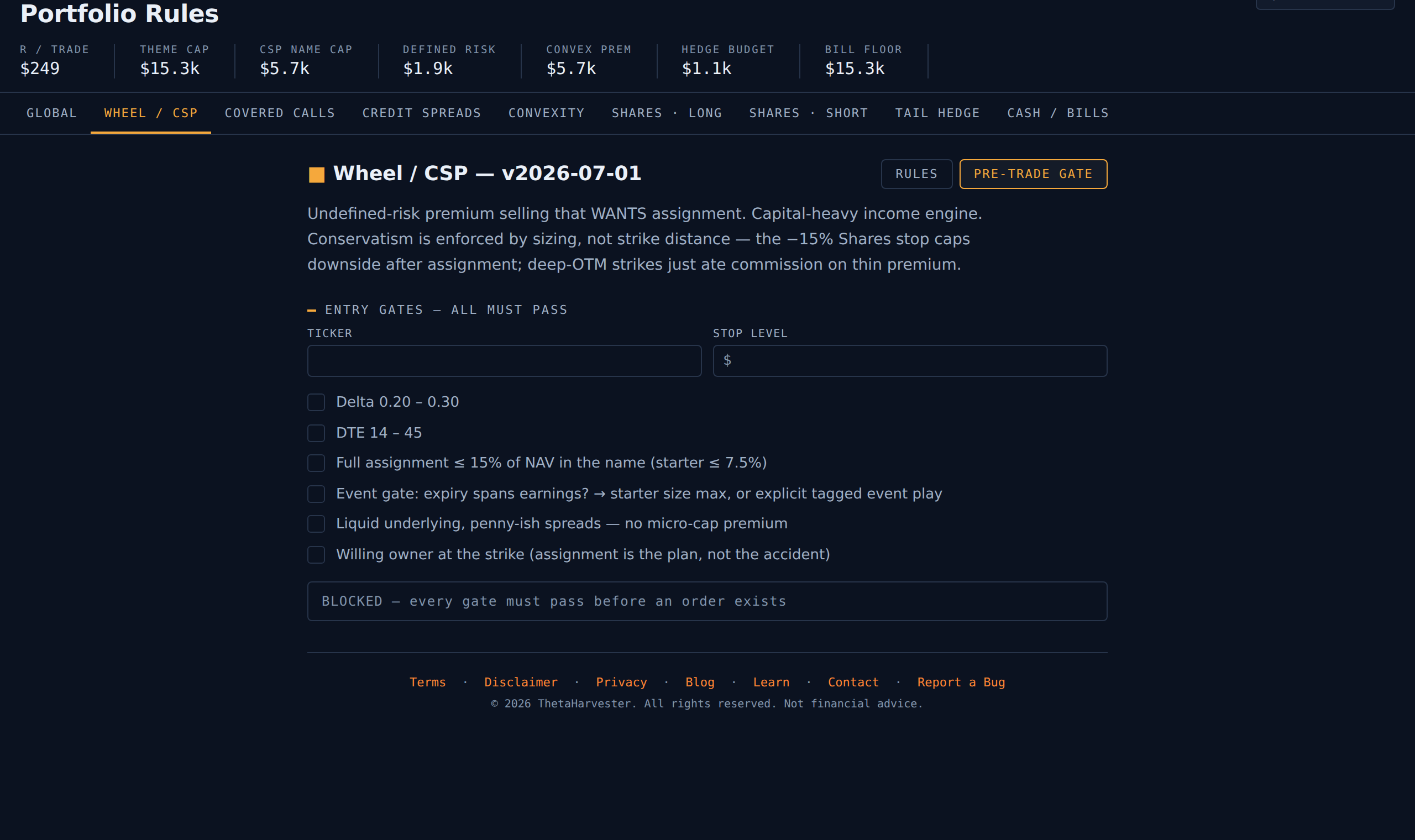
Each sleeve carries a gate: a fixed checklist of conditions that must be ticked before the order goes in. A written invalidation exists. R in dollars is defined and within the cap. The product is actually tradeable in your account. Theme exposure after this trade stays under the cap.
Clearing the gate writes an audit log entry — what you decided, and when, while you were still objective. That log is what makes the later question answerable: not "do I follow my rules?" but "on which specific trades did I not, and what did those cost?"
Filling this in for yourself
If you would rather start from a blank page, this is the structure worth copying:
SLEEVE: [name]
PURPOSE: what this is for / what it is not for
ENTRY GATES (all must be true):
  - [condition]
  - [condition]
SIZING:
  - risk per trade: [x]% of NAV
  - single-name cap: [x]% of NAV
  - sleeve cap:     [x]% of NAV
EXITS (priority order):
  1. [rule]
  2. [rule]
HARD DON'TS:
  - [prohibition]
Repeat per strategy. Express every limit as a percentage. Recompute the dollars whenever NAV changes — or let the rulebook do it.
The plan and the journal are two different documents
The plan states intent. It cannot tell you whether the intent was any good.
That is the Trade Journal's job: it captures the plan as its own record before the trade, then measures how often you deviated, and whether your planned trades outperformed your improvised ones. The rulebook is the hypothesis; the journal is the experiment.
Keeping them separate is what makes both of them honest.
Open Portfolio Rules, set your NAV, and read your own book.
Frequently asked questions
What should an options trading plan include?
An options trading plan should include, for each strategy you run: a purpose statement, entry gates, a position sizing rule, exit rules in priority order, and a list of prohibited actions. Each strategy needs its own section, because rules that are correct for cash-secured puts are wrong for long LEAPs.
How much of my account should I risk on a single options trade?
Most systematic options traders cap risk per trade at roughly 0.5% to 1% of net asset value. The important part is not the exact number but that it is expressed as a percentage of NAV, so the dollar figure moves with the account instead of going stale.
Why should trading plan limits be percentages instead of dollar amounts?
Because dollar limits silently become wrong when your account changes size. A $250 risk cap written at $40,000 NAV is 0.6%; at $80,000 it is 0.3%, so you are under-risking without ever deciding to. Percentages re-peg automatically.
What is a pre-trade checklist in options trading?
A pre-trade checklist is a fixed set of conditions that must all be true before an order is placed — for example delta range, days to expiry, position size within the single-name cap, and no earnings inside the expiry. Its purpose is to make entry criteria verifiable rather than remembered.
What is a trading sleeve?
A sleeve is one strategy bucket within a portfolio, with its own rules and its own capital limit — such as wheel/cash-secured puts, covered calls, credit spreads, or a tail hedge. Splitting a portfolio into sleeves prevents one strategy's rules being applied to a strategy they do not fit.
Why do traders keep breaking their own trading rules?
Most rule breaks are a structure problem rather than a willpower problem. Rules stored in a document you do not open during a session are not available at the moment of decision. Rules break far less often when they are visible at the point of entry and expressed as a specific number rather than a judgement call.
What is the difference between a trading plan and a trading journal?
A trading plan states what you intend to do before the trade. A trading journal records what you actually did and what it returned. The plan is the rule; the journal is the test of whether the rule has an edge. You need both, and they should be separate records.
How often should I update my trading plan?
Update the percentages rarely, and ideally only at a scheduled review rather than after a loss. Update the dollar figures whenever your NAV changes, which should be automatic. Changing rules mid-drawdown is the most common way a plan stops being a plan.
Can one trading plan cover both selling premium and buying long calls?
Not with the same rules. Premium selling and long convexity have opposite risk profiles — one has capped gains and open-ended loss, the other the reverse. They need separate entry gates, separate sizing rules, and separate capital budgets inside one document.
Does a written trading plan actually improve results?
A written plan does not create an edge by itself. What it does is make your process repeatable enough to measure, which is a precondition for finding out whether an edge exists. Without consistent rules, performance data cannot be attributed to anything.