Free Cash Flow Quality: Conversion, Stock Comp & Add-Backs
Short answer: Free cash flow is cash from operations minus capital expenditure — the money genuinely left over. Its quality is tested three ways: FCF conversion (free cash flow ÷ net profit, persistently below 70–80% is a question to answer), stock-based compensation (a real cost paid through dilution, so subtract it for the owner's view), and the working-capital and capitalization lines, where WorldCom hid roughly $11bn of expenses. Capitalizing costs lifts profit and operating cash flow at once — free cash flow is the number it cannot dress up.
Free cash flow is where the accounts meet the bank statement — and where most warnings appear first. People use the phrase "cash flow" to mean at least six different things, and most disagreements about whether a company generates cash are really disagreements about which definition is in play.
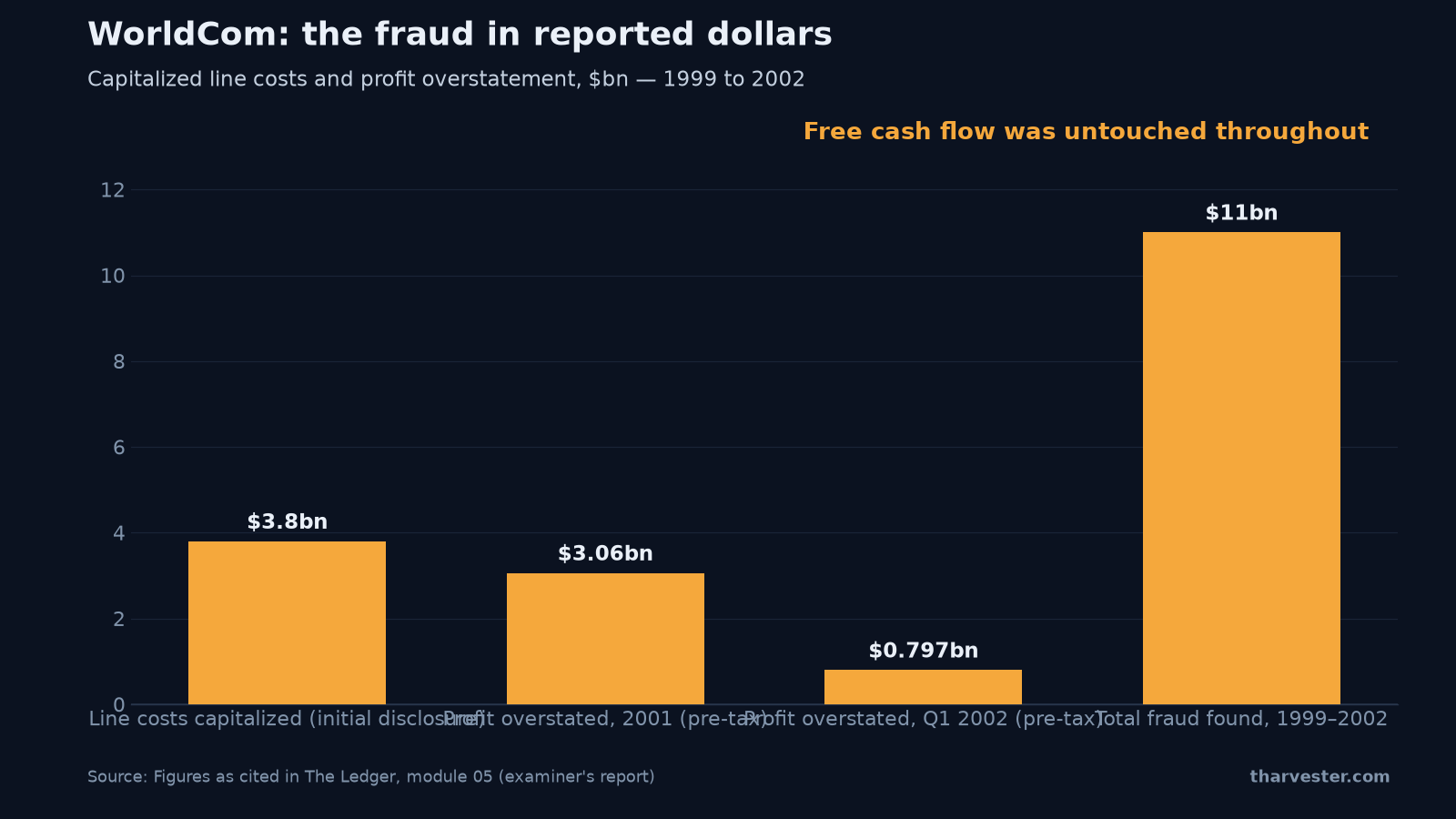
The chart above shows why the definitions matter. It plots the WorldCom fraud in reported dollars: $3.8bn of ordinary network costs initially disclosed as capitalized, profit overstated by about $3.06bn pre-tax in 2001 and $797m in Q1 2002 alone, roughly $11bn of total fraud found by the examiner across 1999–2002. Reported profit and reported operating cash flow both looked healthy the whole time. One number was untouched: free cash flow. We will come back to why.
Free cash flow definitions — pick one and say so
The core ladder, from module 05 of The Ledger:
- Cash from operations (CFO) — as reported in the operating section. A starting point only; always look at the working-capital lines inside it.
- Capital expenditure (capex) — purchases of property, plant and equipment plus capitalized software. The depreciation charge is a rough proxy for the maintenance half.
- Free cash flow (FCF) = CFO − capex. The standard. Use it for cash flow yield, dividend cover and conversion.
- FCF excluding share-based pay — the owner's view where staff are paid heavily in shares.
- Owner earnings — net profit + depreciation − maintenance capex ± working capital change: what the business earns as it currently stands.
Three defensible definitions, three different answers. State yours every time.
FCF conversion: the quickest earnings-quality test there is
Cash conversion divides free cash flow by net profit. It asks the bluntest possible question: did the profit actually show up as money?
A company reporting $392m of net profit and $447m of free cash flow converts at 447 ÷ 392 = 114%. More cash arrived than profit was reported — usually a good sign. A company reporting the same $392m of profit but only $180m of free cash flow converts at 46%, and you now have a specific question: where did the other $212m go? Persistently below about 70–80% is a question to answer, not a verdict — and the answer is always in one of the two sections below.
Stock-based compensation: the add-back that is not really non-cash
Share-based compensation is pay handed over as shares rather than cash. The cash flow statement adds it back as a non-cash cost, because no money left the company. That is accurate bookkeeping and misleading analysis: the cost was real, and it was paid by existing shareholders through dilution of their ownership.
The module's arithmetic makes it concrete. A company reporting $500m of free cash flow while issuing $450m of stock to staff has around $50m of cash flow that genuinely belongs to owners — plus a rising share count. Share-based pay running above roughly 10–15% of revenue, combined with buybacks that only cancel out the new shares, means headline free cash flow overstates reality by a wide margin. This gap does real damage precisely because it is fully disclosed and routinely ignored — which is why it is a workhorse of the short side.
The quick check: divide SBC by revenue, this year and three years ago. A company scaling successfully should see that percentage fall. Flat or rising means the cost of running the business includes handing over a growing slice of your ownership every year.
The working-capital lines inside CFO
Inside cash from operations sit lines that describe timing rather than trading — and they move first when something goes wrong. Receivables are money customers owe the company; inventory is unsold stock; payables are money owed to suppliers. Rising receivables or inventory use cash up; rising payables free it.
- Receivables growing much faster than revenue — customers not paying, longer credit terms to win orders, or stock pushed onto distributors. The two growth rates should be roughly similar.
- Inventory outgrowing revenue — demand was misjudged and a write-down is coming. In retail and consumer hardware, one of the most reliable early warnings there is.
- Payables stretching sharply — cash flow improved by paying suppliers later. Not repeatable, and it can stop abruptly.
- Deferred revenue falling while reported revenue rises — the company is working through a backlog rather than winning new business.
Capitalizing costs: the WorldCom playbook
When a company spends money, it must decide whether the spending is an expense — charged against this year's profit — or an asset, recorded on the balance sheet and charged gradually over future years. Moving spending from the expense column to the asset column is called capitalizing it. Most capitalization is a legitimate judgment call. The mechanics are what you need to understand, because they produced the largest fraud on the list.
WorldCom leased capacity on other telecoms' networks. Those payments — line costs — were ordinary running expenses. Beginning in 1999, the company recorded them as capital investment in network infrastructure instead. Operating profit rose. Operating cash flow rose. Capital spending rose quietly, in a section of the accounts fewer people read. An internal auditor, Cynthia Cooper, found it in June 2002; the company filed for bankruptcy a month later.
Here is the part that makes this module matter: free cash flow was untouched, because the money had genuinely gone out of the door either way. Capitalizing a cost lifts profit and CFO simultaneously — but FCF subtracts capex, so the reclassified spending is deducted again on the way out. Free cash flow would have told you what profit did not.
Run the mechanics yourself in the course's interactive bridge:
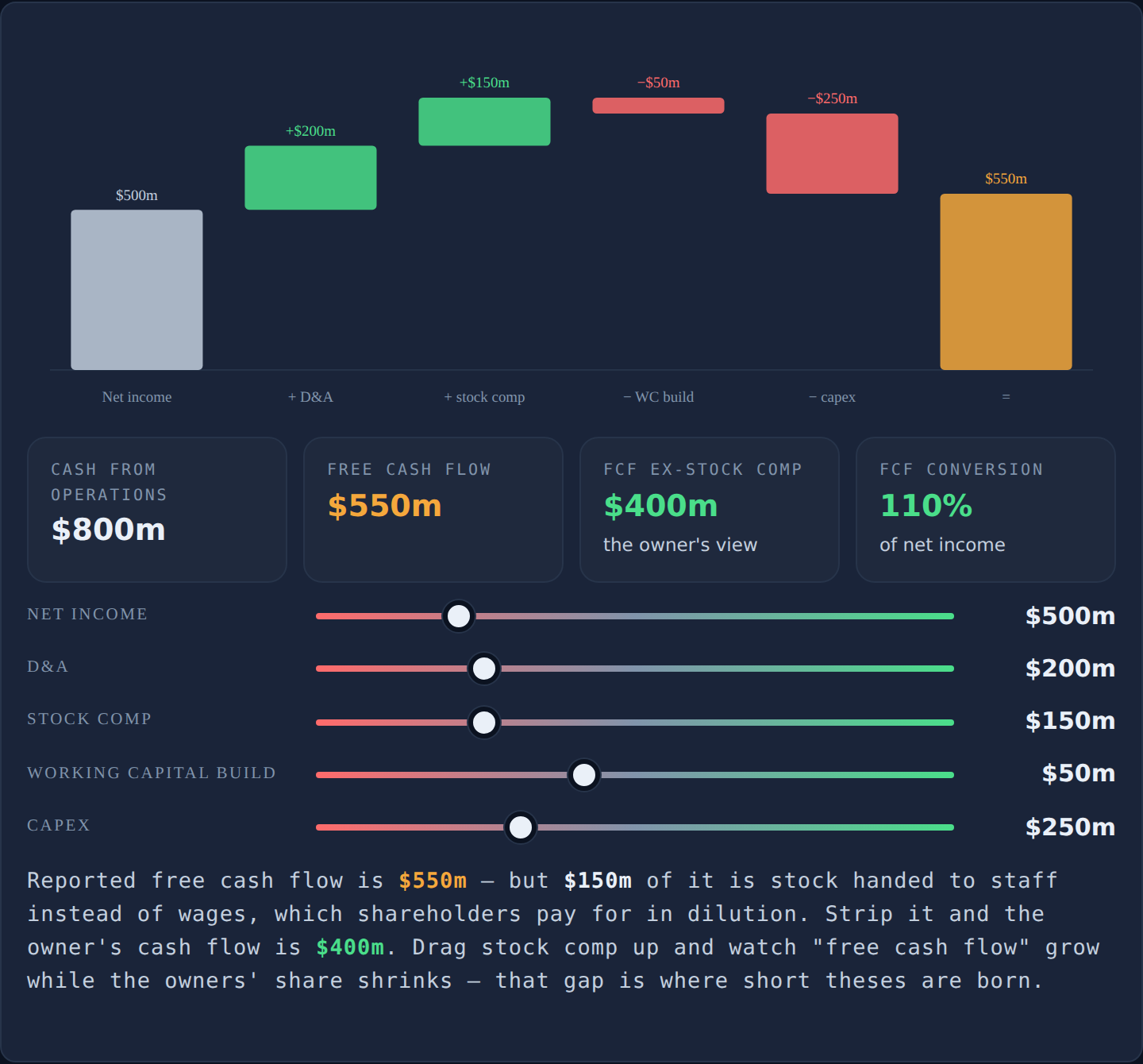
Drag capex up while nudging net income up by the same amount — that is the capitalization trade WorldCom made, and watch the readouts: CFO rises, but free cash flow barely moves, and FCF conversion as a percent of net income quietly deteriorates. Then drag stock-based compensation up and watch the gap open between FCF and FCF ex-SBC — that gap is what stock pay costs you as an owner. Finally push the change in working capital negative (receivables piling up) and see a healthy profit turn into weak cash on the waterfall. Profit is an opinion; the bridge shows you where the opinion parts from the facts.
Where this sits in the course
This is module 05 of The Ledger. It follows ROIC vs WACC — because returns computed on paper profit inherit paper's flaws — and feeds directly into net debt and interest coverage, where weak cash generation meets a repayment calendar. The full lesson adds drills on the capitalization policy note and the three-FCF calculation, the Ratio Bench keeps every formula on one page, and the Fundamentals Grader computes FCF margin and yield for any ticker. Unfamiliar terms are in the glossary.
Read module 05: cash flow quality and the add-backs — and make the bank statement your referee.
Frequently asked questions
What is free cash flow in simple terms?
Free cash flow is cash from operations minus capital expenditure — the money genuinely left over after running the business and maintaining its equipment. It is the standard input for cash flow yield, dividend cover and conversion. Stricter versions also subtract share-based compensation (the owner's view) or only maintenance capex (owner earnings). State which definition you used, every time — three defensible definitions give three different answers.
What is a good FCF conversion ratio?
FCF conversion is free cash flow divided by net profit. A company reporting $392m of net profit and $447m of free cash flow converts at 114% — more cash arrived than profit was reported, usually a good sign. Persistently below about 70–80% is a question to answer, not a verdict: the same $392m profit with only $180m of free cash flow converts at 46%, and you now need to find the missing $212m.
Why is stock-based compensation added back to cash flow?
Because no money left the company: staff were paid in shares, not cash, so the accounting adds the cost back as non-cash in the operating section. That is accurate bookkeeping and misleading analysis. The cost was real — it was paid by existing shareholders through dilution of their ownership rather than out of the bank account.
Should you subtract stock-based compensation from free cash flow?
For the owner's view at companies that pay staff heavily in shares, yes. A company reporting $500m of free cash flow while issuing $450m of stock to staff has around $50m of cash flow that genuinely belongs to owners, plus a rising share count. SBC above roughly 10–15% of revenue, with buybacks that only cancel the new shares, means headline FCF overstates reality by a wide margin.
What does it mean to capitalize a cost?
Recording spending as an asset on the balance sheet, charged gradually over future years, instead of as an expense against this year's profit. Buying a factory is clearly an asset; the electricity bill is clearly an expense; software development and contract costs sit in between. Capitalizing raises reported operating profit and operating cash flow at the same time, because the spending moves to the investing section.
How did WorldCom hide its losses?
WorldCom leased capacity on other telecoms' networks — ordinary running expenses called line costs — and from 1999 recorded them as capital investment instead. The initial disclosure was $3.8bn of capitalized line costs; profit was overstated by about $3.06bn pre-tax in 2001 and $797m in Q1 2002 alone, and the examiner's report put the total fraud near $11bn. Free cash flow was untouched throughout, because the money left either way.
What is the difference between operating cash flow and free cash flow?
Cash from operations (CFO) is the top section of the cash flow statement, before any spending on equipment. Free cash flow subtracts capital expenditure from it. The distinction matters because reclassifying a cost from operating expense to capital investment inflates CFO but not FCF — which is exactly why FCF is the harder number to manipulate.
Why do receivables growing faster than revenue matter?
Receivables are money customers owe the company. When they grow much faster than revenue, the company is selling to customers who are not paying, offering longer credit to win orders, or stuffing distributors with stock. Profit is being recorded well before cash arrives — the classic divergence that shows up in a falling conversion ratio before it shows up anywhere else.