Options Foundations: Learn Calls, Puts & Payoff Diagrams Interactively
Most options education starts with strategies. Iron condors on day one, Greeks by lunchtime, and somewhere in the noise the actual instrument — the contract itself — never gets explained.
The Options School takes the opposite route. Its first level, Foundations, spends four short lessons on one question: what is this thing you're about to trade? Every lesson has an interactive figure, and the mini apps below are the real ones from the course — drag the sliders and the numbers are live.
An Option Is a Contract That Sells You a Choice
An option fixes four things on one page: the underlying (100 shares), the strike written in ink, the expiry date, and the premium — the price of the contract itself, paid up front and never refunded.
The word that names the instrument is the buyer's right, not obligation, to use it. A call is a price-lock coupon to buy at the strike: gold if the stock climbs above it, binned if it doesn't. A put is the right to sell at the strike — a floor under a position.
Try it. This is the decision machine from the What is an option lesson — a $100-strike option. Flip Call/Put, drag the stock price, and watch the verdict swing between exercise and walk away:
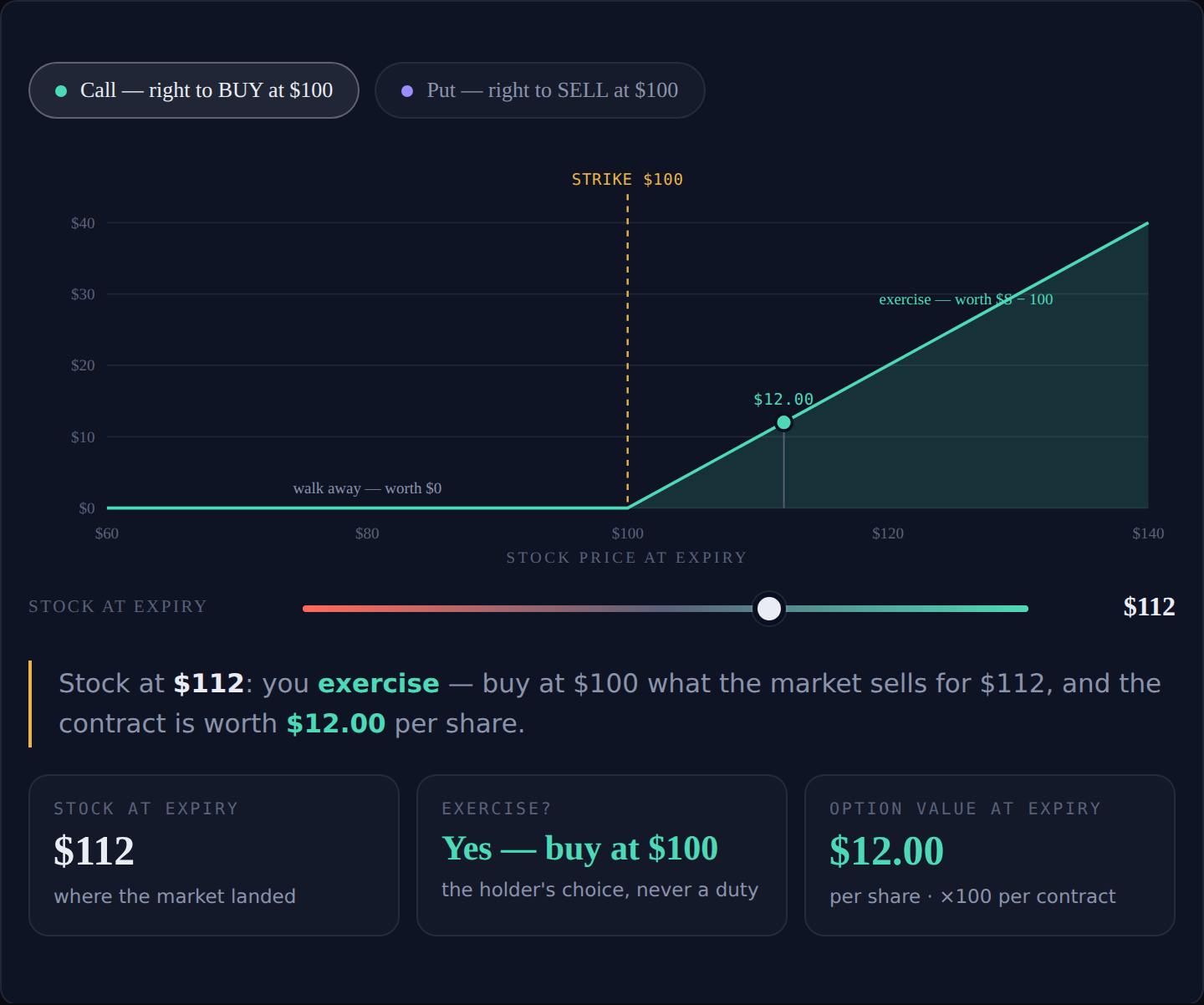
Notice the shape of the value line: flat at zero, then a straight ramp. A right you don't have to use can never hurt you — which is why a buyer's maximum loss is always the premium, and why every option has a seller getting paid, up front and every time, to carry the other side.
The Hockey Stick: Payoff Diagrams
Options people communicate in one chart: profit or loss per share at expiry, plotted against where the stock lands. Every basic position is a hockey stick — flat on one side of the strike, a 45-degree ramp on the other.
The trap beginners fall into: the kink is not the breakeven. A buyer starts one premium in the hole, so a $100 call bought for $5 needs the stock at $105 just to get the money back. At $103 it finishes in the money and still loses $2.
This is the payoff builder from the Payoff diagrams lesson. Flip between the four basic positions, drag the strike and premium, and watch the breakeven marker move:
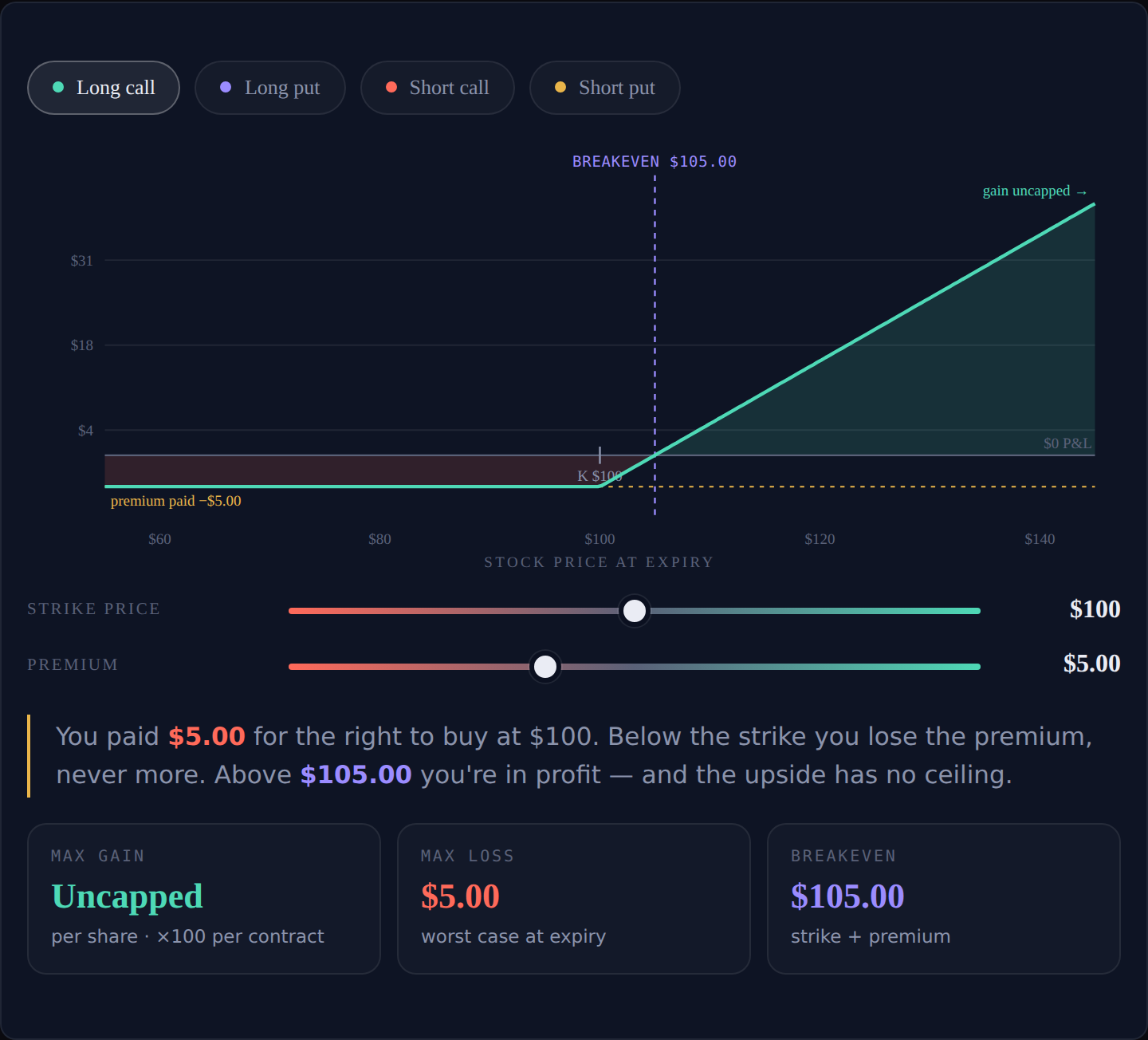
Flip to Short put and study the geometry every premium seller lives with: gain capped at the premium, loss running nearly to zero. That asymmetry is the entire risk story of the wheel strategy — visible in one bent line.
Intrinsic vs Extrinsic: The Only Split That Matters
Cut any option premium with a knife and you get exactly two parts. Intrinsic value is what exercising banks right now. Extrinsic value is everything above that — the market's live price for what might still happen before expiry.
The split matters because the two parts behave differently: intrinsic never decays — it's just money changing pockets — but extrinsic melts to zero on a schedule. It is the only part of a premium that can be systematically harvested, which is why this site is called what it's called.
Here's the value-split explorer from the Intrinsic vs extrinsic lesson — the premium drawn as stacked bands across every stock price:
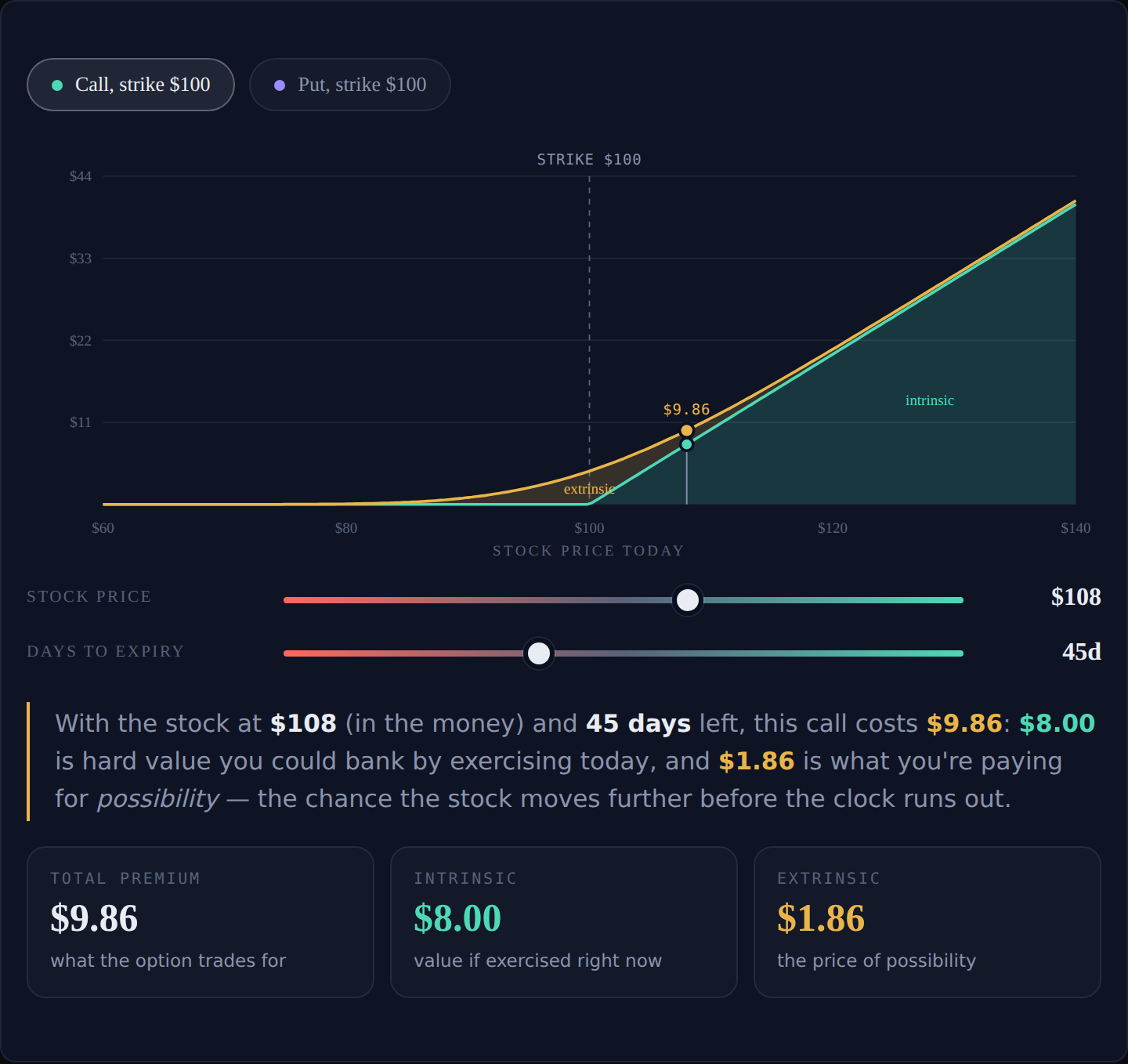
Note where the gold band is thickest: at the money, where the coin-flip is most alive. Deep ITM and far OTM, the "maybe" is nearly settled and the market pays almost nothing for it.
Expiry and Assignment: Where the Maybe Ends
At the closing bell on expiry day, the bookkeeping is mechanical: U.S. equity options in the money by $0.01 or more are auto-exercised — no phone call, no opt-in — while OTM contracts simply cease to exist. For sellers, assignment is the mirror image: deliver shares at the strike on a short call, buy 100 shares at the strike on a short put.
The last explorer from the Expiry & assignment lesson runs the clock down and shows the value curve collapsing onto the intrinsic hockey stick — plus the live probability of finishing ITM, which is exactly the seller's assignment odds:
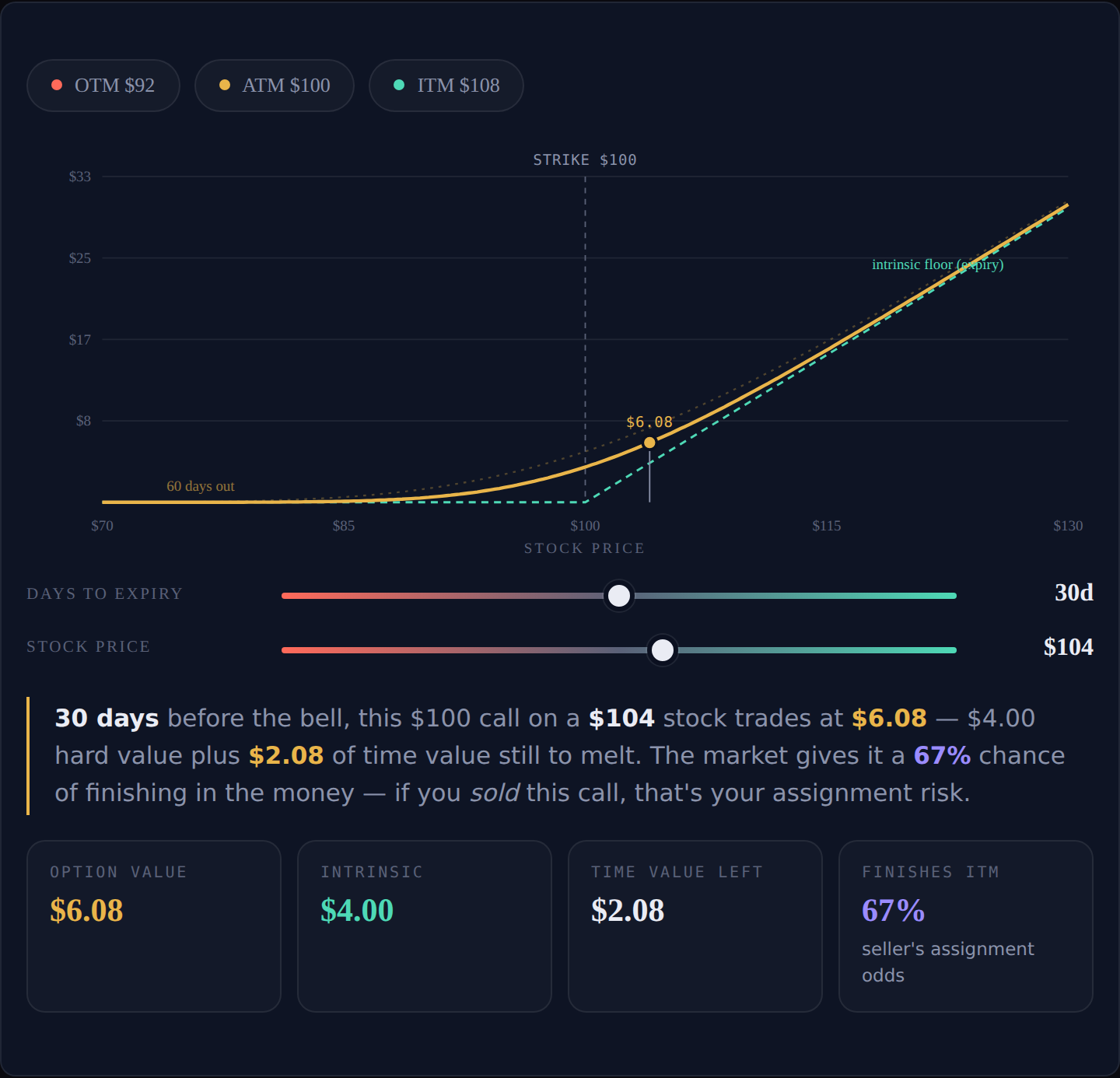
Sellers who pick strikes they'd genuinely honor turn assignment from a fear into logistics. That mindset — assignment as a plan, not an accident — is the seed of the whole wheel strategy, three levels up the curriculum.
Take the Full Course
These four figures are lifted straight from the Foundations course in the Options School — free, no signup, with a short quiz on every lesson to make it stick:
- What is an option — strike, expiry, premium, and the right-not-obligation
- Payoff diagrams — the hockey stick and the real breakeven
- Intrinsic vs extrinsic — the two-part premium and why sellers farm the second part
- Expiry & assignment — auto-exercise, pin risk, and American vs European style
From there the curriculum climbs through The Greeks, Volatility & Skew, The Wheel, and Risk & Position Sizing — and when you're ready to grade a real trade, the ThetaHarvester tools are one click away.