Investment Thesis Template — Scorecard, Invalidation & Sizing
Short answer: An investment thesis is one page with seven parts: the one-sentence claim, what you believe that others don't, the catalyst and its rough date, pessimistic/central/optimistic valuations, falsifiable invalidation criteria written before entry, position size derived from the distance to invalidation, and a monitoring plan. Act only when the reward-to-risk ratio between the outer cases clears roughly 2:1 — the central case tells you which way to face, not whether to act.
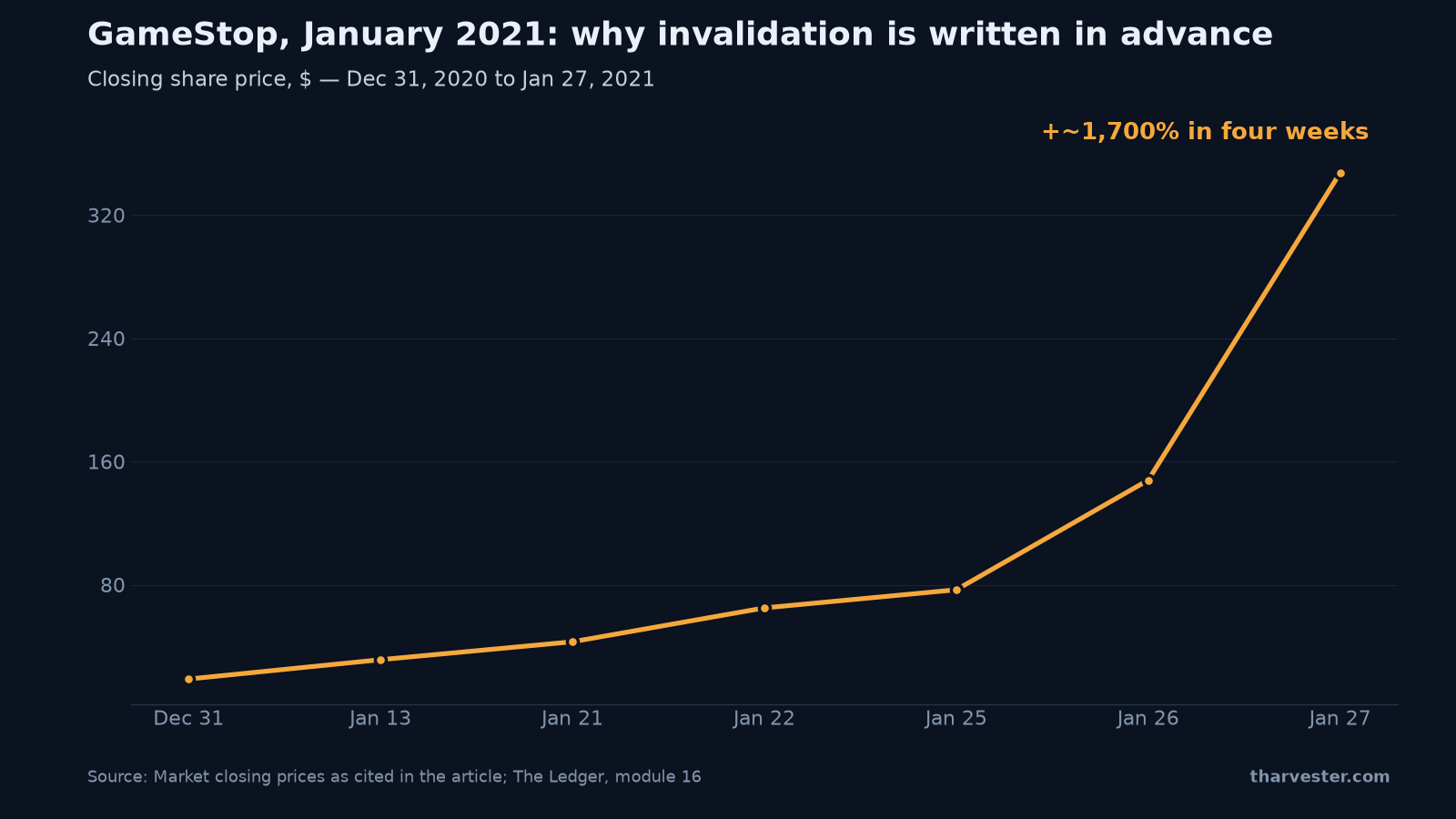
In four weeks of January 2021, GameStop went from $18.84 to a closing price of $347.51 — a rise of roughly 1,700% — and short sellers betting on the death of mall retail lost billions. Most of them were arguably right about the business. What many lacked was a written answer to three questions: what converts this view into a price move, what would prove me wrong, and how crowded is this trade with reported short interest near 140% of the float?
Those questions are the subject of the final module of The Ledger, ThetaHarvester's free fundamental analysis course. Module 16, The decision, turns research into a position you can defend, review honestly, and exit without changing the story to suit the outcome. This companion article walks through its investment thesis template, the scorecard, and the invalidation discipline the chart above argues for.
What goes in an investment thesis? Seven headings, one page
An investment thesis is the written case for a position — one page, seven headings, completed before any money is committed. The purpose is not bureaucracy. It is that in twelve months you will not remember what you originally thought, and your memory will have quietly rewritten it to match whatever happened since.
- One sentence. "I think this company is worth more/less than its price because ___, and the market has this wrong because ___."
- What you believe that others do not. This is your variant perception — a specific belief that differs from consensus, with evidence. If you cannot name one, you do not have an edge; you have an opinion that is already in the price.
- The catalyst. What converts your view into a price move, and roughly when — results, a refinancing, a contract renewal, a regulatory decision, a patent expiry. For a bearish case this is mandatory, not optional.
- The numbers. A pessimistic, central and optimistic valuation, each with its assumptions written beside it.
- What would prove you wrong. Specific, observable facts, written in advance.
- How much, and in what form. Size follows from how far the price can move against you before the case is disproved, and how confident you are — not from how interesting the idea feels.
- What you will check each quarter — and deliberately ignore.
Everything above the thesis feeds this page. The course's earlier modules supply the evidence: returns against the cost of capital, cash flow quality, the balance sheet, valuation against expectations. If you need the raw material fast, the Fundamentals Grader scores a ticker's metrics against sector peers in seconds, and the Ratio Bench explains what each ratio can and cannot tell you.
The scorecard: weigh the case before you size it
The module has you score a company on ten weighted factors, each from −3 (strongly negative) to +3 (strongly positive). The total is not the point, and it will not make the decision for you. The point is to notice when a high score comes from one factor carrying six weak ones — the single most common way a research process fails. Two strong arguments and some decoration is not a strong case.
The interactive lab below distills the exercise to six pillars. Try it on a company you know:
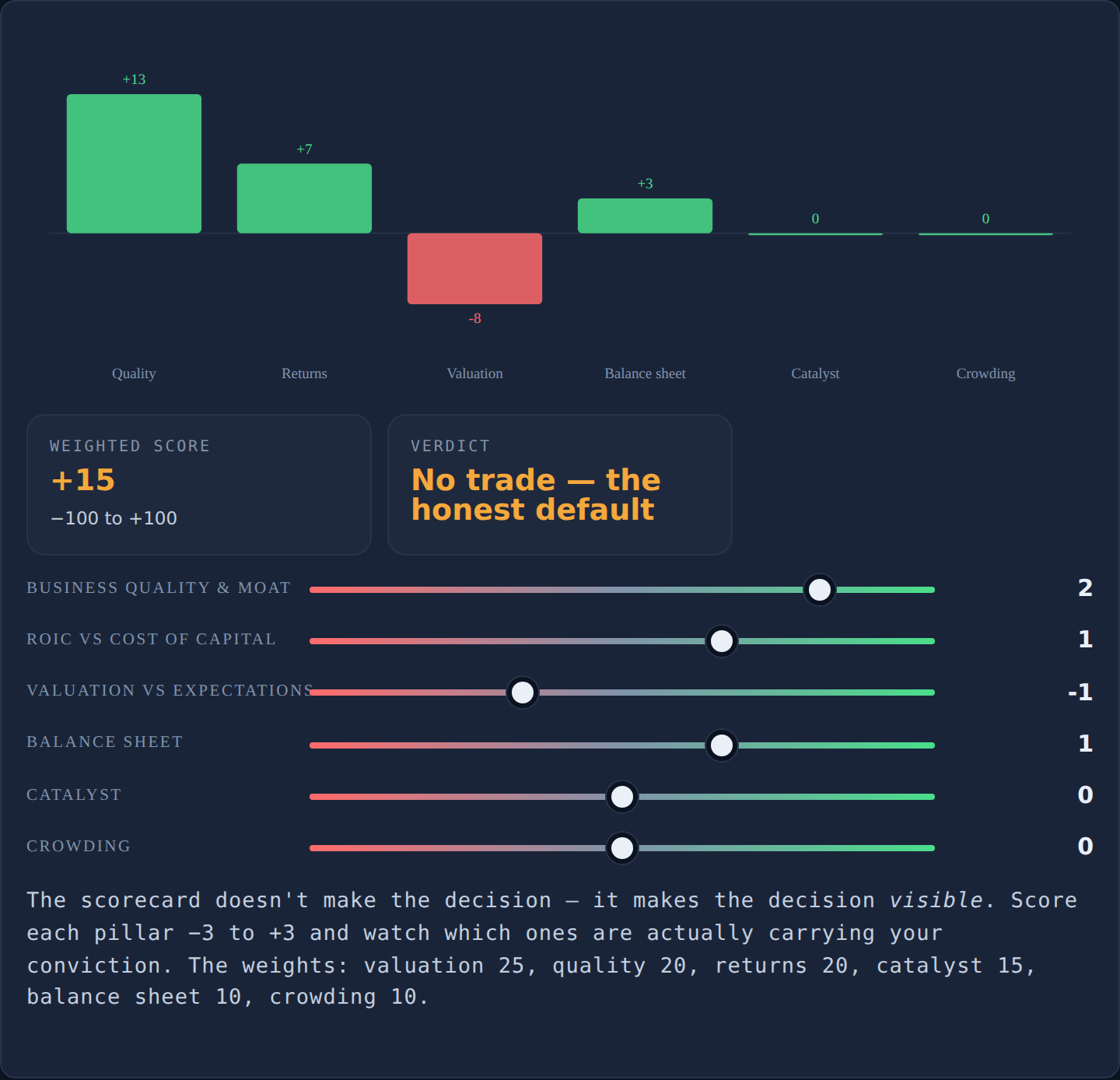
Six sliders, each running −3 to +3: business quality & moat, returns vs cost of capital, valuation vs expectations, balance sheet, catalyst, and crowding. The lab reads out a weighted score and a verdict — long, no trade, or short — and, more usefully, it warns you in two specific situations: when one pillar is carrying the whole score, and when a short verdict has no catalyst behind it. Push valuation to +3 and leave everything else near zero and watch the warning appear; that is the "cheap for a reason" trap rendered as a slider. Then build a short — negative quality, negative valuation — with catalyst at zero, and note that the lab objects. That objection is the GameStop chart at the top of this page, compressed into a rule.
Thesis invalidation criteria: write down what proves you wrong
Invalidation is section five of the page, and it is the section people skip. "If the story changes" is not an invalidation. "If net debt to EBITDA goes above 4, or if organic growth is negative for two consecutive quarters" is one, because you can check it without arguing with yourself.
The module's quiz makes the discipline concrete. You short an indebted retailer expecting it to fail to refinance. It announces a discounted share issue, repairs its balance sheet — and the shares fall 22%. The written invalidation should still take you out: the funding gap you were betting on no longer exists, whatever the price did. Staying in means holding a different position — "this is a bad retailer" — that you never researched and never sized. Closing when the mechanism resolves, rather than reaching for a new reason to stay, is what separates a process from a habit.
Reward to risk: why the central case is not the decision
Here is the module's worked example. A share trades at $10. Your three cases: optimistic $14, central $11.50, pessimistic $5.50.
- Upside to the optimistic case: $14 ÷ $10 = +40%
- Upside to the central case: $11.50 ÷ $10 = +15%
- Downside to the pessimistic case: $5.50 ÷ $10 = −45%
- Reward to risk: 40 ÷ 45 ≈ 0.9 : 1
The central case is positive, so the instinct is to buy. But you are risking 45% to make 40%, which means you must be right well over half the time simply to break even — and nobody is. Compare a share offering +60% against −20%: that is 3 : 1, and it can be wrong most of the time and still make money across a series of decisions. The comparison between the two outer cases, not the central estimate, decides whether an idea is worth acting on. Under about 2:1, think harder.
Run the pre-mortem before the market runs it for you
A pre-mortem inverts the usual forecasting exercise. Assume it is twelve months from now and the position has lost a third of its value. Write the story of how — not "the market fell," but what specifically went wrong inside this company. Then check the current accounts for early signs of that exact story. This single exercise catches more bad decisions than any additional model, because it forces you to search for disconfirming evidence while you can still act on it.
Monitoring: thesis drift, and keeping score
After entry, the page keeps working:
- Each quarter, update only the two or three variables the case depends on. Everything else is noise wearing the costume of information.
- Watch for thesis drift — quietly adopting new reasons to hold because the original ones stopped working. Re-read what you wrote at the start, word for word, every quarter.
- A single disappointing quarter is not automatically an exit. What proves you wrong is what you defined in advance — nothing more, nothing less.
- Keep the decision and the outcome in separate columns. Good decisions produce bad outcomes routinely, and bad decisions produce good ones. Only the record across many decisions separates skill from luck.
The end of the course
This is the final lesson of The Ledger — 17 modules from what a stock price actually tells you to this one-page decision, free and with no signup, each with drills and a quiz. If you arrived here directly, the previous companion piece covered the capital cycle and industry structure, the layer of analysis that sits just above the single company, and the glossary defines every term the course uses in one line each.
Take the full lesson: The decision — scoring it, writing it down, and knowing when you are wrong
Frequently asked questions
How do you write an investment thesis?
One page, seven headings, written before any money moves: a one-sentence claim of why the company is worth more or less than its price and why the market has it wrong; the specific belief you hold that differs from consensus, with evidence; the catalyst that converts your view into a price move and roughly when; pessimistic, central and optimistic valuations with assumptions beside each; what would prove you wrong, stated as checkable facts; position size and structure; and what you will check each quarter versus deliberately ignore.
What are thesis invalidation criteria?
Specific, observable facts — defined before you enter — that mean your case is broken: a measure crossing a level, a guidance cut, a large customer lost, a refinancing completed. "If the story changes" is not an invalidation; "if net debt to EBITDA goes above 4, or organic growth is negative for two consecutive quarters" is, because you can check it without arguing with yourself.
What is a good reward-to-risk ratio for a stock position?
As a working rule, below about 2:1 between your optimistic and pessimistic cases, think harder before committing. A setup risking 45% to make 40% is roughly 0.9:1 and requires being right well over half the time just to break even. A setup offering +60% against −20% is 3:1 and can be wrong most of the time and still make money over a series of decisions.
What is a pre-mortem in investing?
You imagine it is twelve months later and the position has lost a third of its value, then write the detailed story of how — not "the market fell," but what specifically went wrong inside the company. Then you check the current accounts for early signs of that exact story. This one exercise catches more bad decisions than any additional model.
What is thesis drift and how do you avoid it?
Thesis drift is quietly adopting new reasons to hold a position because the original ones stopped working. The defense is mechanical: write the case down, dated, before entry, and re-read it word for word every quarter. If the reasons you now give for holding are not the reasons on the page, you are holding a different, unresearched position.
How should you size a stock position?
Position size follows from two things: how far the price can move against you before your case is disproved, and how confident you are — not from how interesting the idea feels. A thesis whose invalidation point sits far below the entry price needs a smaller position for the same portfolio risk than one that is proven wrong quickly.
Do short positions need a catalyst?
Yes — for a bearish case, a named catalyst with a rough date is mandatory rather than optional. A short position pays borrow fees and carries unlimited theoretical downside while you wait, and a crowded short can be squeezed regardless of the fundamentals, as GameStop's January 2021 rise from $18.84 to $347.51 demonstrated. Without an event that forces the market to reprice, being right eventually can still mean losing first.
How often should you review an investment thesis?
Quarterly, and narrowly. Update only the two or three variables your case actually depends on — everything else is noise wearing the costume of information. A single disappointing quarter is not automatically an exit; what proves you wrong is what you defined in advance, nothing more and nothing less. Record the decision and the outcome separately, because only the record across many decisions separates skill from luck.